Collaboration with Mongolia - Global Communication Report #10
February 20, 2023
Global Communication Report #10 - Collaboration with Mongolia
Dr. Raadan Odbileg (Researcher, Institute of Veterinary Medicine)
Dr. Nyamsuren Ochirkhuu (Lecturer, Faculty of Veterinary Medicine, Mongolian University of Life Sciences)Livestock production is a major industry in Mongolia, but various infectious diseases of livestock are still endemic. Since 2005, our laboratory has conducted joint research with Mongolian researchers to control infectious diseases of livestock in Mongolia. This February, Dr. Konnai visited Mongolia for the first time in six years after the pandemic to discuss the resumption of collaborative research in Mongolia, which had been suspended.
Dr. Odbileg worked on camel and cattle immunology research in our laboratory and returned to Mongolia after receiving her PhD degree in 2005, where she continues to work mainly on viruses at the Institute of Veterinary Medicine in Ulaanbaatar. Dr. Ochirkhuu returned to Mongolia in 2017 after receiving his PhD degree and is now a lecturer and research coordinator at the Faculty of Veterinary Medicine of the Mongolian University of Life Sciences.
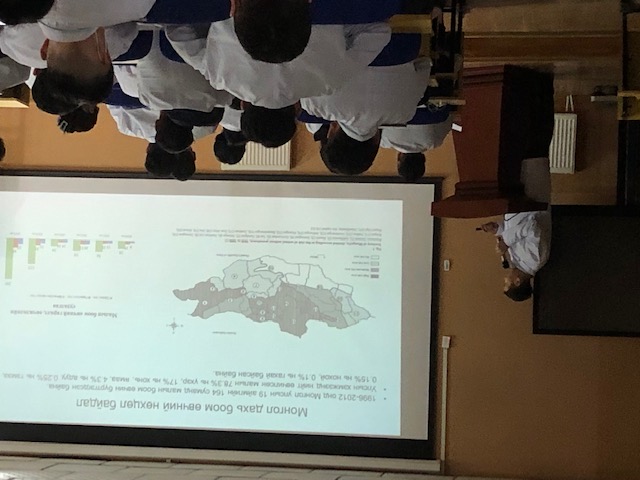
When Dr. Konnai visited the university, Dr. Ochirkhuu was giving a lecture on anthrax and brucellosis (both zoonotic diseases in Japan) to about 120 third-year veterinary students. According to Dr. Ochirkhuu, there were more than 100 cases of anthrax and brucellosis in livestock in Mongolia last year alone, and unfortunately, there were also human deaths. In addition, there are currently outbreaks of to foot-and-mouth disease, small ruminant disease, Lampysskin disease, and sheep pox in Mongolia. He and his colleagues are conducting diagnosis of these infections and taking measures in cooperation with veterinarians throughout Mongolia. Until two days before this visit, Dr. Ochirkhuu had just traveled to a rural area 1,500 km away from Ulaanbaatar (it takes two days by car to travel there) to hold a local countermeasure meeting. In the area, they also confirmed new outbreaks of Maedi-Bisna and caprine arthritis/encephalitis, and were shown diagnostic specimens collected by local veterinarians and others. Fortunately, these livestock infectious diseases have not been confirmed in Japan.
However, with the recent internationalization of the livestock industry, there is a danger of various infectious diseases entering Japan. Our laboratory plans to collaborate with overseas research institutions to develop novel controls against these infectious diseases in domestic and foreign livestock.
<Lecture by Dr. Ochirkhuu>
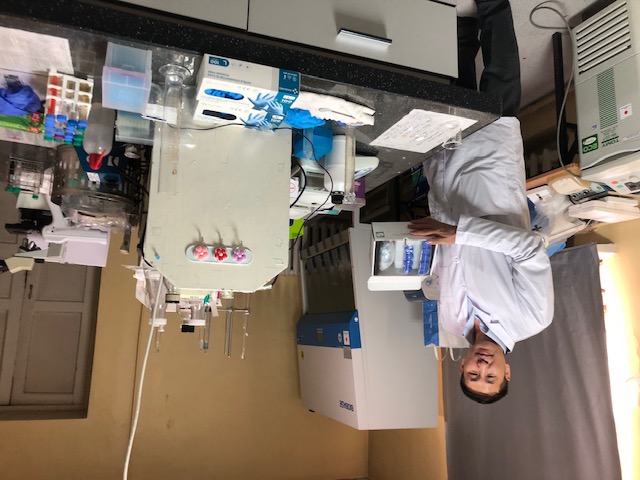
<Laboratory at the Faculty of Veterinary Medicine, Mongolian University of Life Sciences>
<From left to right: Dr. Odbileg, Dr. Ochirkhuu, Dr. Konnai, and Dr. Otgontuya>