
Study on Marek’s disease
Marek’s disease virus (MDV: family, Herpesviridae; subfamily, Alphaherpesvirinae; genus, Mardivirus; species, Gallid alphaherpesvirus 2) is the causative agent of Marek’s disease (MD), which manifests as malignant lymphomas in infected chickens. After MDV enters through the respiratory tract, an early cytolytic infection is induced. Then, T cells are activated, and latent infection is established in these activated T cells. MDV transforms a few latently infected cells, which develop into malignant lymphomas. Although formerly caused serious economic losses to the poultry industry, MD is currently well controlled by vaccination using attenuated strains of MDV. To date, a few vaccines used for the prevention of tumor progression can be available, and therefore, MD vaccines have been studied and discussed as a model of vaccines against tumor progression.
We started researches on MD in 1970s, and have been conducted many research activities over time: search for tumor-associated antigens using MD-derived cell lines, mechanism(s) of tumor development, biological/genetic difference(s) between pathogenic and attenuated (vaccine) strains, mechanism(s) of vaccine-induced protection, immunosuppression in MD pathogenesis, and so on. Furthermore, we surveyed and clarified the prevalence of MDV in wild birds, since the first report of an MD case in white-fronted goose found in Japan, 2001.
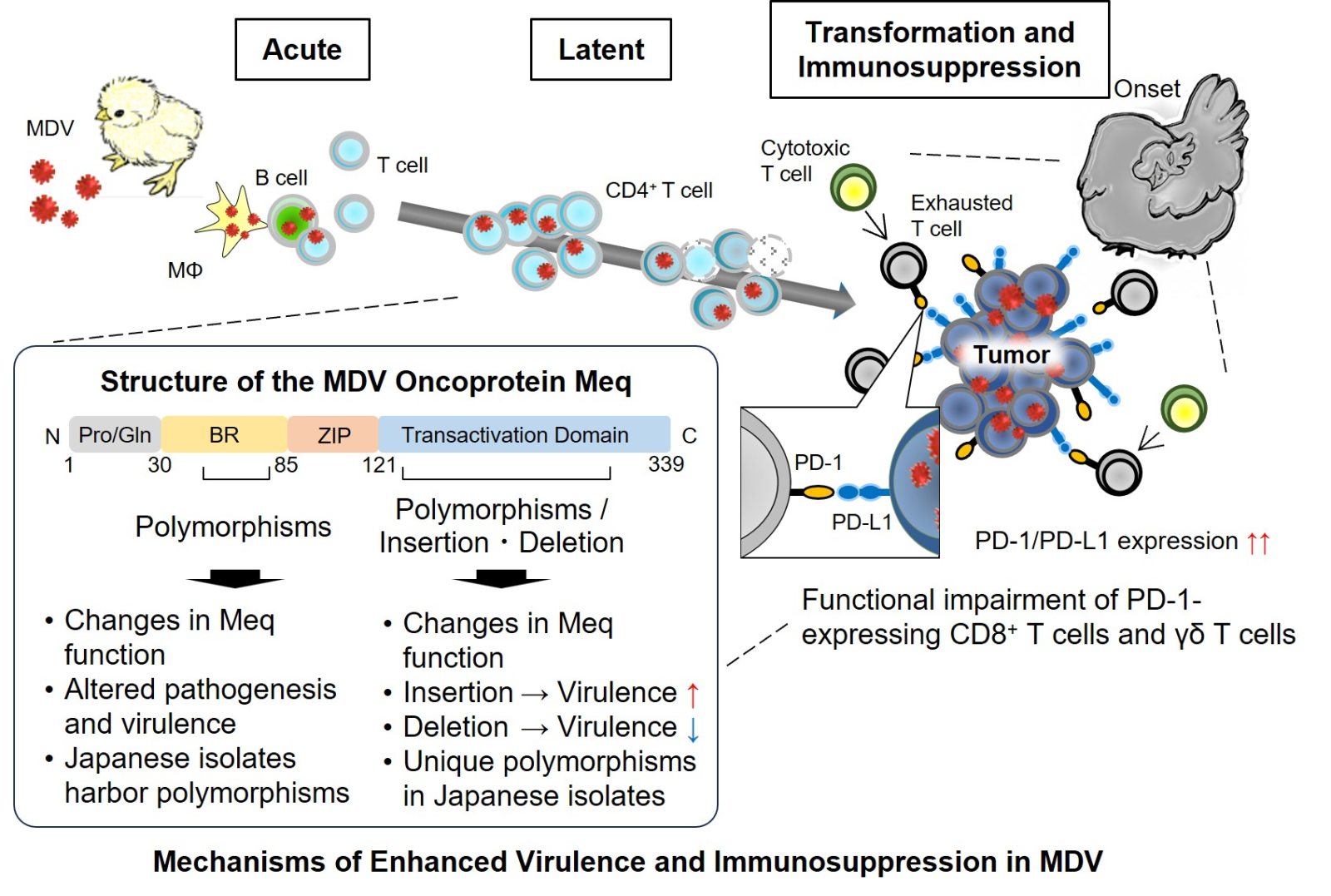
MD can be prevented by vaccination as described above. However, there are still some problems, and these problems are called as “vaccine breaks”; MD is developed even in vaccinated chickens due to greater virulence of field strains, and the vaccine breaks are reported worldwide. In Japan, MD cases are sporadically reported. To solve these problems, we conduct the following three studies.
(1) Elucidation of the Mechanisms Underlying Increased Virulence of MDV and Development of Novel Vaccines
Several polymorphisms associated with virulence have been identified in the MDV genome. Among them, sequence variations in the viral oncogene meq have been reported to correlate with differences in virulence. To investigate the role of meq, we generated recombinant MDVs carrying modified meq genes and conducted infection experiments. Our results demonstrated that polymorphisms in meq strongly influence MDV virulence and disease progression. We are currently developing attenuated recombinant MDVs through targeted mutations in the meq gene and evaluating their potential as novel vaccine candidates.
(2) Characterization of MDV Strains Circulating in Japan
Marek’s disease has been the most frequently reported notifiable poultry disease in Japan since 2017 (as of June 2026). We have isolated MDV strains from chickens diagnosed with Marek’s disease in commercial poultry farms and performed genetic analyses of these Japanese isolates. Our findings revealed that Japanese MDV isolates are closely related to strains identified in Europe and Asia, particularly those isolated in China. We are currently generating recombinant MDVs based on Japanese field isolates and investigating their biological and pathogenic characteristics.
(3) Elucidation of the Immunosuppressive Mechanisms Induced by MDV
MDV is thought to employ various immune evasion and immunosuppressive mechanisms to establish and maintain latent infection. In our recent studies, we demonstrated that MDV-infected and transformed T cells highly express the immune checkpoint molecule PD-1, which is associated with impaired immune function. We are currently investigating the relationship between the expression of PD-L1, a ligand of PD-1, and immune responses in MDV-infected chickens to better understand the mechanisms of MDV-induced immunosuppression.